Sunday, December 5, 2010
The Impact of Open Source
Online learning provides excellent opportunities for students to learn effectively. The internet and the personal computer in general have changed the way we think about teaching and learning (Simonson, Smaldino, Albright, & Zvacek, 2009). In the past learning was teacher-centered but as instructional designers, we must design courses that are student-centered. Student-centered learning strongly promotes active learning, collaboration, mastery of course material and student control over the learning process (Simonson, Smaldino, Albright, & Zvacek, 2009). Prior to taking this course, I was not aware of the different types of online learning course nor was I was I was aware of how much work is put into the design of an online course. This course has definitely been an eye-opener for me. This week I learned about Open Courses. These are free courses anyone can take online to acquire knowledge and engage in learning experiences. I chose to review the Open Yale courses at http://oyc.yale.edu/. Open Yale Courses provides free and open access to a selection of introductory courses taught by distinguished teachers and scholars at Yale University. The aim of the project is to expand access to educational materials for all who wish to learn (Open Yale courses, n.d.). The site was very user-friendly and easy to navigate. I enjoy courses that are designed with simplicity. Sometimes graphics, animations, etc. can take away from the learning experience. Since this course provided general knowledge on different topics, there were different subjects on the side of the page one could click on if they were interested in taking a particular course. After I clicked on psychology and entered into the course another page opened with the course content. The course content was very basic and included introduction to psychology, syllabus, class sessions, downloads and survey. If the student clicks on each one of these links, it will take them to the necessary page. I think the course I reviewed was carefully pre-planned and designed for a distance learning environment. There was an overview of what to expect in the psychology course and it connected to the class sessions appropriately. Resources were provided through different modes such as video, audio, and text. I think this course followed the recommendations of online learned as listed in the text. The psychology course was learner-centered because it produced learning, the environment was cooperative, individualistic, collaborative, and supportive, and success is possible for all due to the fact that it would be determined by the learner’s knowledge and skills. Success can occur because the learners will learn at their own pace. The course designer could have added more components that would have maximized active learning. The course is a synchronous course. If it would have been asynchronous, discussion forums could have been added so the learners could learn from one another as well as the instructor. I enjoyed reviewing the psychology course and I plan to access it in the future to continue learning more about psychology.

Sunday, November 21, 2010
Selecting Distance Learning Technologies
For this week’s assignment, I chose example one on the collaborative training environment. This scenario entailed a new automated staff information system being purchased for a major corporation and had to be implemented in six regional offices. There would be a problem with the implementation because the staff was located throughout all the different offices and could not meet at the same time or in the same location. As an instructional designer, I would have to deliver a training workshop to each of the six locations keeping in mind that each office must share the same information as well as ongoing collaboration. Completing this task would involve distance learning due to the fact that each office was in a different location and communication would need to occur to effectively deliver the content. The scenario did not include the number of people being training but I am assuming that if was taking place at the regional offices, that the managers would receive the training and more than likely redeliver the information to the staff at each location. In distance education, it is imperative that educators think about how communication will occur and how to apply experiences that will promote effective and efficient learning. More than likely, a variety of techniques will be needed to provide equivalent learning experiences for all students (Simonson, Smaldino, Albright, & Zvacek, 2009, pp. 94). The only information that I have is that the staff needs to share information thru documents and screen captures and online collaboration is necessary. I could use the old- fashion method of using powerpoints and giving everyone a copy to follow along as I read each page, because I know that is not effective and would not work for a major company. Before implementing the training I would give a pre-assessment to get some feedback on what the learners already know about the content being delivered. Following the training, I would complete a post survey to make sure learning occurred and areas of improvement. In order to deliver this new staff information system I would use a learning management system such as a Blackboard. Discussion technology would be integrated through the Blackboard and could take place asynchronously since the staff could not meet at the same time or in the same location. I would use the web software such as Elluminate or WebEx because it is an online learning environment with voice over Internet Protocol (VoIP), video, and collaboration options that allows teachers and students to interact as if face-to-face ( The Technology of Distance Education). This software would allow me to effectively deliver the new staff system to all the regional locations and everyone would receive the content they needed to redeliver to their company.
Simonson, M., Smaldino, S., Albright, M., & Zvacek, S. (2009). Teaching and learning at a distance: Foundations of distance education (4th ed.) Boston, MA: Pearson.
The Technology of Distance Education.(n.d.). Multimedia Technology.Retrieved November 21, 2010 from Walden University.
Simonson, M., Smaldino, S., Albright, M., & Zvacek, S. (2009). Teaching and learning at a distance: Foundations of distance education (4th ed.) Boston, MA: Pearson.
The Technology of Distance Education.(n.d.). Multimedia Technology.Retrieved November 21, 2010 from Walden University.
Sunday, November 7, 2010
Definition of Distance Learning
Distance learning is a topic that can be viewed from different perspectives. We can view distance learning through the educational aspect or the business aspect. The bottom line is that distance learning is impacting our global society and every individual must keep up and stay abreast of current trends in technology. I define distance learning as a group of learners obtaining education thru the use of technology. According to Schlosser & Simonson (2006, p.1), distance education is defined as institution-based, formal education where the learning group is separated, and where interactive telecommunications systems are used to connect learners, resources, and instructors (as cited in Simonson, M., Smaldino, S., Albright, M., & Zvacek, S., 2009). I do not know why the definition is always changing. I would say the definition depends on the individual who defines it and their knowledge of distance learning. No matter how the term is defined, it is centered on learning through technology.
Before taking this course I never thought of distance learning and how it was defined. I always said I was taking online courses or getting a degree online. In undergrad, I took a course through distance learning where I was in one city and the instructor was in another. It was a live feed through the television where I could see the professor on the screen and he could see the students on the screen where he was located. Since taking that course all of my college classes have been directly online. Therefore my view of distance learning has been centered on just that, online learning. I forgot that distance learning is more than just using the computer to learn and receive instruction. This week I learned many new things about distance learning that I did not know before. I did not know that distance learning courses began in 1833 through mail correspondence in Europe and by 1873 was offered in the United States (Distance Learning Timeline Continuum, n.d.). The timeline showed the history of distance learning and how it originated in the 1800’s and advanced all the way to the 21st century. Learning the foundation and historical aspect of distance learning from this week’s resources gave me a better understanding of the term and the ability to redefine the word. Now if asked to define distance learning, I will say it is a form of education where the teacher and learner are separated by space and time. Communication through email, teleconferencing, and written text make up for the physical absence between the teacher and learner.
Every individual has their opinion about distance learning based on knowledge and personal experience. This mode of learning does not work for all learners. The individual must be aware of their learning style and must be tech-savvy if distance learning is their choice to learn. Distance learning has many benefits and challenges and must be put on a balancing scale. Distance learning will require change in order for growth and success to occur. Depending on the organization that uses distance learning, they will have to make changes depending on their needs. With technology advancing everyday and more traditional colleges offering distance learning courses, I think it will completely take over education in the future. Working people will continue to choose this style due to balancing home and work. In order for working people to continue their education, distance learning will provide the best benefits for them. Businesses will have to keep up with distance learning as well in order to train employees and compete with a global market. I see a mass takeover in the future with distance learning. With modern technology and the ability to handle all of your business from home using the internet, traditional classes will continue to decline. Distance learning has been around for many years and will continue to increase educational opportunities for learners.
Multimedia Program. (n.d.). “Distance Learning Timeline Continuum”
Simonson, M., Smaldino, S., Albright, M., & Zvacek, S. (2009). Teaching and learning at a distance: Foundations of distance education (4th ed.) Boston, MA: Pearson

Sunday, December 27, 2009
Learning Theory & Instruction Reflection
When I think of the term learning theories and instruction, I think of ways people learn and how instructors create learning environments that make all learners successful. Prior to taking the course Learning Theories and Instruction, I was already aware of learning theories because I am an educator. Learning theories are very popular in the field of education and most instructors form their philosophy of education on learning theories. The problem with instructors forming a philosophy of education is that it is their personal belief and may or may not apply to other learners. Since taking this course, I have learned that an effective instructor does not use one learning theory alone; all learning theories intertwine and work together. I now have a deeper understanding of the importance of learning theories. I now understand that the instructor must recognize each theory and incorporate it into the curriculum. In today’s society, it is obvious that not all students learn the same way and in order for success to occur, different teaching approaches are necessary. Instructors cannot use single learning theories in their course. The way the instructor designs the curriculum and the way they teach the curriculum can affect the student’s learning outcome and academic success. Innovative technology is on the rise and it is important for people to stay abreast of the latest trends in technology. I have learned how to make the connection between learning theories and educational technology. Connectivism is a recent learning theory for the new digital age and makes a connection between technology and the real world. I have also learned about the role motivation plays in learning. Adult learners have a need and desire to learn different from young college students. Young college students have environmental factors that prohibit them from being motivated in class. Adult learners base their learning off real life experiences and quickly finish their coursework because most of the time it is work related. Most adult learners take online courses to further their education or increase their pay. This course has given me a new understanding of learning theories and the vital role each one plays in the field of education. Even though I took courses during college that were in a traditional setting, since taking online courses, I know that I am an online learner. I think I learn best using the constructivist approach, but since I have learned about all the learning theories, I can no longer base my learning on constructivism alone. As I further my career, I will always have the background knowledge of learning theories. I will always be able to meet the needs of all learners and make modifications and accommodations when necessary.
Sunday, December 20, 2009
Technology and Learning Theories
Even though I have a deeper understanding of different learning theories, I do not think my view on how I learn has changed. The deeper understanding only helped me become more aware of different learning theories and how they link to one another. When learning occurs, I may use different learning theories together but my learning style is still based on the constructivist theory. It also helped me realize that changes in technology will continue. My knowledge and awareness of all learning styles will ensure that I am reaching all learners and their learning experience will be beneficial. Over the past few weeks, I have important information about learning theories through the weekly resources as well as classmates. I have learned that we solely base our learning on personal experiences and we continue to store information in our memories. This further explains why I have always believed in the constructivist theory, because in our daily lives whether personal or educational, it is based on an experience we have had in the past or related to a real-life experience. Technology plays a key role in my life. All of my work and communication at school where I work centers around technology. I have to do the daily attendance, input grades, teach using the interwrite board, assess students, and communicate through emails all using technology. In an elementary setting, I have to differentiate instruction. If one of my students is not grasping a concept, sometimes I will pull up a PowerPoint lesson or a video on united streaming. This technology really helps students who are struggling. I was never one who liked traditional classroom settings. Since online learning started, I have had beneficial learning experiences. My job and home life is time consuming so online learning for me is a great way for me to continue my education. Technology helps me learn new things such as new programs and software, create new projects and learn new information.
Saturday, December 5, 2009
Connectivism
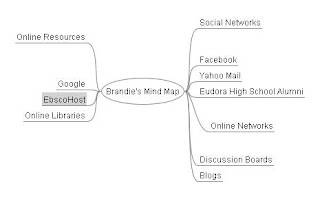
My network is centered totally around technology. I will truly say that I am an online learner. I will say this can be positive and negative at the same time. If I am in a meeting, I find myself drifting or doing something on the computer when I should be listening to the speaker. Traditional learning has never been for me but I learn using a variety of learning strategies. Whether I am at work or at home, I am doing something on the internet. I think this is due to the fast pace of society and technology being innovated in new ways everyday. The school where I work has gone digital, so as an educator it is important for me to stay on top of changes in technology. To me, the internet was the best thing invented. Now that I am an online learner, I find the majority of my resources online. I can complete research and work without leaving my home. I think digital tools are anything you can use in addition to the internet, which will help, enhance the online experience. Software, games, and online libraries are just a few of some digital tools that have helped enhance the way I learn online. When I have questions about what I am learning, I normally do some research by googling the topic to see if I can gather some information. Most of the time, I find what I am looking for and the answer is scholarly and useful. I think my personal network aligns with the connectivism theory. Connectivism is a new theory for the digital age. Since I am an online learner, I have to look more into this theory and have an understanding of what it is and how it works. Teaching and learning go hand in hand and has become more networked, therefore connectivism must be integrated along with behaviorism, cognitivism, and constructivism in order to work.
Subscribe to:
Posts (Atom)